Rebrandly built its name on branded short links — the idea that your short URLs should carry your domain instead of some generic shortener. That core value proposition is sound. Branded links genuinely do get more clicks, build more trust, and give you better attribution data.
The problem is the price. Rebrandly's free plan gives you 10 links per month and 1 custom domain. The paid Starter plan jumps to $24 per month for 5 custom domains and 5,000 links. For freelancers, small businesses, and early-stage teams, that's a lot to pay for a link management tool when the market has moved on.
Several alternatives now offer branded links, full analytics, and API access — some at a fraction of Rebrandly's cost, some completely free. This guide compares the best options, explains exactly what Rebrandly's limitations are, and helps you choose the right fit for your actual workflow.
What Rebrandly's free and paid plans actually give you
Before switching tools, it's worth understanding exactly what you're leaving behind — and what you're paying for on Rebrandly's paid tiers.
The free plan includes 10 short links per month, 1 custom domain, basic click counting, and a UTM builder. There's no access to detailed analytics like device breakdown, referrer source, or geographic data on the free tier. API access is not included. For a platform built around branded links, the 1-domain limit on the free plan is genuinely restrictive for teams managing more than one brand or product.
The Starter plan at $24 per month increases this to 5,000 links per month and 5 custom domains, adds 1 year of analytics retention, team collaboration features, and link retargeting. The Basics plan at $39 per month increases to 15 custom domains. Enterprise pricing goes higher from there.
Where Rebrandly genuinely earns its cost is in brand governance features: consistent link naming conventions, team permissions, audit logs, and deep integration with marketing automation platforms. If you run a large team where compliance and link governance matter, Rebrandly's tools are legitimately useful. For most other use cases, you're paying for infrastructure that doesn't match your scale.
Five things to check before choosing a Rebrandly alternative
The right alternative depends on why Rebrandly isn't working for you. Before comparing tools, identify the specific gap — because the best answer for a developer team is different from the best answer for a solo marketer.
First, how many custom domains do you actually need? If the answer is one, many platforms give you that for free. If you manage links across several brands, you need a platform that supports multiple domains on an accessible plan.
Second, what analytics do you actually use? Some teams need device breakdown and referrer data to make creative decisions. Others just need total click counts. The right analytics tier depends on what you're measuring.
Short.io — the most generous free plan for branded links
If Rebrandly's primary pain point is the price, Short.io is the most direct upgrade. The free tier includes 1,000 branded short links in total (not per month — a cumulative cap), 5 custom domains, 50,000 tracked clicks per month, QR codes, a UTM builder, and full API access. No credit card required to start.
To put that in context: Rebrandly charges $24 per month for 5 custom domains with 5,000 links per month. Short.io gives you 5 custom domains with 1,000 links total, completely free. For teams that create links in batches for campaigns rather than continuously generating new links, the 1,000 total cap often lasts months before a paid upgrade is needed.
Short.io's analytics include real-time clickstream data, geographic breakdown by country and city, device type, OS, referrer source, and UTM campaign grouping. The custom domain setup takes about 5 minutes — you add a CNAME or A record in your DNS provider and links start resolving through your domain immediately.
Paid plans start at $5 per month for the Hobby tier, which raises link volume and tracked clicks considerably. For teams moving off Rebrandly Starter at $24/mo, Short.io's paid plans represent significant savings with comparable or better features.
Dub.co — best for developers and teams who need advanced attribution
Dub.co is the alternative that's grown the fastest in the last two years, and it's done so by targeting developers and growth teams who want more than a basic branded link tool. The free plan includes 25 new links per month, 3 custom domains, QR code generation, UTM templates, full API access, and 30-day analytics retention.
What genuinely differentiates Dub from Rebrandly — even at paid tiers — is the attribution layer. Dub supports geo-targeting (different destinations for different countries), device routing (different landing pages for iOS vs Android), password-protected links, link expiry dates, and conversion tracking. These are features Rebrandly offers only at higher enterprise tiers, and Dub includes several of them on the paid plan from $8 per month annually.
For development teams, Dub's REST API is well-documented with SDKs for JavaScript, Python, and Ruby, plus a Zapier integration for no-code automation. If you're building a product that creates short links programmatically, or if you need to route different audiences to different landing pages from one short link, Dub is the strongest technical alternative to Rebrandly in this list.
Dub.co vs Rebrandly on developer features
Rebrandly's API is available from the Starter plan at $24/mo. Dub.co's API is available on the free plan. For teams building link-creation automation or integrating short links into their product, Dub's free API access alone can justify the switch before even comparing analytics or pricing.
Cuttly — best free analytics without paying anything
Cuttly sits in an interesting position in this comparison. It doesn't have the brand governance depth of Rebrandly or the developer features of Dub, but it offers the most comprehensive analytics on a completely free plan — with no credit card, no link ads, and no analytics gating.
The free tier includes 30 new links per month, 1 branded custom domain, and a full analytics breakdown from the very first link: total clicks, unique clicks, device type, operating system, browser, device brand, country, referrer source, and time-of-day patterns. That is analytics depth that Rebrandly reserves for paid tiers and that most other free plans don't match.
Cuttly also includes a Link in Bio page builder and QR code generation on the free tier — useful if you need a simple landing page for social media profiles alongside your branded links. For freelancers, solo marketers, and small agencies who want professional-grade analytics without a monthly commitment, Cuttly covers the core use case.
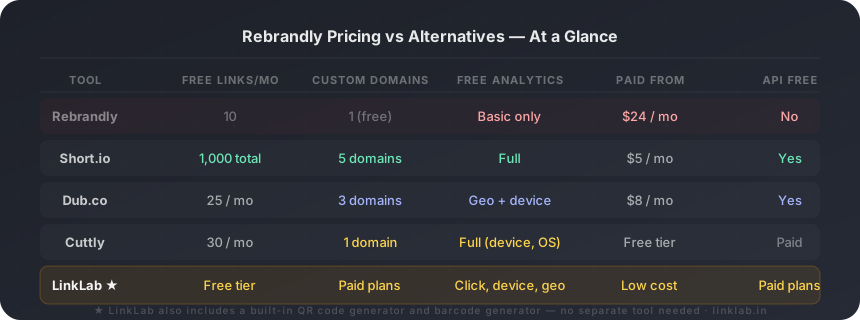
Rebrandly vs alternatives — free plan comparison
| Tool | Free links/mo | Custom domains | Free analytics | API free | Paid from |
|---|---|---|---|---|---|
| Rebrandly | 10 | 1 domain | Basic clicks only | ✗No | $24/mo |
| Short.io | 1,000 total | 5 domains | Full (device, geo, referrer) | ✓Yes | $5/mo |
| Dub.co | 25 | 3 domains | Geo, device, referrer | ✓Yes | $8/mo |
| Cuttly | 30 | 1 domain | Full (OS, browser, country) | Paid only | Free tier |
| LinkLab | Free tier | Paid plans | Clicks, device, referrer | Paid plans | Low cost |
Every alternative gives you more on the free plan than Rebrandly — especially on analytics and domain count.
LinkLab — URL shortener, QR codes, and barcodes in one tool
LinkLab fills a different gap from the other alternatives on this list. Where Short.io, Dub, and Cuttly focus entirely on link shortening and analytics, LinkLab combines URL shortening with a full QR code generator and barcode generator in a single dashboard. If your team regularly creates campaign short links, QR codes for print materials, and barcodes for product packaging, that consolidation has real practical value.
Every short link includes click analytics — referrer, device type, country, and time data — without needing to configure anything separately. Custom domains are available on paid plans so your links carry your brand. The API gives developers programmatic access to link creation, QR generation, and analytics retrieval. No-expiry links mean your campaign links don't break after a set period, which is a real risk with some free platforms.
For teams currently managing three separate tool subscriptions — a link shortener, a QR code platform, and a barcode generator — consolidating to LinkLab can simplify both the workflow and the billing significantly.
Try LinkLab free — no credit card required
URL shortening, QR codes, and barcodes in one place. Branded links on paid plans.
When it still makes sense to stay on Rebrandly
Being honest about this matters: Rebrandly is not a bad product. It has genuine strengths that certain teams genuinely need.
If you're managing branded links at scale across a large marketing team — with strict naming conventions, role-based permissions, approval workflows, and deep integration into your marketing automation stack — Rebrandly's governance features are the most mature in the market. These are capabilities that Short.io and Dub.co don't match at any price point.
Rebrandly also has integrations with Salesforce, Zapier, and several enterprise-grade marketing platforms that smaller alternatives haven't prioritised. If your branded links need to flow through complex CRM or automation workflows, verify that your chosen alternative supports the integrations you depend on before migrating.
The practical test: if you're managing fewer than 50 branded links per month, don't need complex team permissions, and aren't embedded in an enterprise marketing stack — the alternatives above will serve you better at lower cost.
How to choose the right Rebrandly alternative for your situation
The correct choice depends on which Rebrandly limitation is actually affecting your work right now.
If the price is the issue and you need branded links in volume for free, Short.io's free plan — 1,000 total links across 5 custom domains with full analytics — is the clearest like-for-like upgrade from Rebrandly Starter without the $24/mo commitment.
If you're a developer or your team creates links programmatically, Dub.co's free API tier is meaningfully more accessible than Rebrandly's API access (which requires a paid plan). Dub's geo-targeting and conversion tracking also give you attribution features that Rebrandly charges enterprise rates for.
If analytics depth is the gap — you want device, OS, browser, country, and referrer data without paying for it — Cuttly's free plan is the strongest option. It covers more analytics dimensions than Rebrandly's paid tiers in most categories.
If you also need QR codes and barcodes for the same campaigns and products, LinkLab is the only tool that covers all three workflows under one subscription.